
You are planning a whole-home renovation, close to a full gut, and you want to know one thing. Can you get some of that HST back?
You might. If the work is big enough to count as a substantial renovation under the CRA, you can claim the renovation HST rebate and recover a large share of the HST you pay, through the GST/HST New Housing Rebate. The rule is strict, but 2026 made the payoff bigger.
How much bigger? A qualifying renovation can now reach up to $130,000 in combined HST relief. The table below shows how that breaks down.
Not sure whether your scope is big enough to qualify? Pin that down first, before demolition starts.
TL;DR
- Qualify: Some near-total, whole-home renovations qualify when they meet the CRA’s 90% substantial renovation test and all the other conditions.
- New for 2026: Ontario’s enhanced rebate can raise HST relief on projects that start between April 1, 2026 and March 31, 2027, on homes worth under $1.85 million.
- Plan and document: Lock the scope early with a builder who works to the CRA rules, and keep your original invoices and permits for six years.
- File smart: Use the owner-built forms (GST191 plus the Ontario schedule) and ask a tax professional if anything is unclear.
Here is the 2026 rebate at a glance.
| Item | Detail |
| Provincial relief | Up to $80,000 of the 8% provincial part |
| Federal relief (ONHAP) | Up to $50,000 of the 5% federal part, paid separately by Ontario |
| Combined maximum | Up to $130,000 |
| Start window | Work begins April 1, 2026 to March 31, 2027 |
| Completion | Substantially completed before 2030 |
| Value limit | Finished home worth under $1.85 million |
| Use | Your or a close relation’s primary residence |
Source: CRA Notice 346, Ontario Enhanced New Housing Rebate. This is a temporary program with firm dates, so confirm the current rules with the CRA or your accountant before you rely on them.
What Changed With Ontario’s Enhanced HST Rebate in 2026?
Before 2026, the numbers were smaller. The standard federal rebate shrinks as your home’s value goes up, and it hits zero at $450,000, which most substantial renovations pass. Ontario’s standard rebate could still apply. The 2026 changes add a temporary enhanced Ontario rebate and the ONHAP, a separate Ontario payment tied to the federal part of the HST. So the potential relief is much bigger than it used to be.
Ontario’s HST is 13%. It splits into an 8% provincial part and a 5% federal part. The enhanced program gives relief on both, in two parts.
The provincial part. The Ontario enhanced rebate, plus the existing Ontario rebate, returns up to $80,000 of the 8% provincial part you paid. How much you get depends on what the finished home is worth.
| Home value at substantial completion | Provincial rebate (8% part) |
| Up to $1 million | Full rebate, up to $80,000 |
| Over $1 million and up to $1.5 million | Flat $80,000 |
| Over $1.5 million and under $1.85 million | Partial rebate |
| $1.85 million and above | No enhanced rebate; the standard Ontario owner-built rebate may still apply, up to $16,080 if you did not pay HST on the land, or $24,000 if you did |
The federal part. The Ontario New Home Affordability Payment, or ONHAP, is a separate payment from the Province of Ontario, worth up to $50,000. It covers up to 100% of the 5% federal part of the HST. You do not file a separate form for it. You give consent on your rebate form, and Ontario pays it after the CRA reviews your claim. The ONHAP is reduced by any federal GST/HST new housing rebate or first-time home buyers’ rebate you are entitled to.
Add the two parts and the program can reach $130,000 on a qualifying home. That is a ceiling, not a set cheque. What you actually get depends on the HST you paid, what the finished home is worth, and whether you meet every condition. For a renovation, the rebate is worked out from the HST on your construction invoices. So keep those invoices clean from day one.
Four rules set eligibility for an owner-built substantial renovation:
- The work has to start between April 1, 2026 and March 31, 2027.
- It has to be substantially completed before 2030.
- The finished home has to be worth less than $1.85 million.
- The home has to be where you or a close relation will live as a primary residence.
What the Renovation HST Rebate Actually Is
The GST/HST New Housing Rebate lets you recover some of the GST, or the federal part of the HST, on a new or substantially renovated home. The catch is that the home has to be your primary residence, or a close relation’s, and you have to meet the other conditions.
Two things trip people up. The rebate is not open to a corporation or a partnership. And Ontario has its own rebate on the provincial part of the HST, which the 2026 changes made bigger.
People call this a renovation HST rebate. The CRA files it under new housing.
The 90% Test That Defines a Substantial Renovation
Here is the rule in plain terms. A substantial renovation means you gut the inside. Generally, 90% or more of the interior of the existing house has to be removed or replaced.
You do not have to touch the foundation, outside walls, supporting walls, roof, floors, or staircases to meet the 90% test. If you do replace those during the work, the HST on that part can still count when the renovation qualifies.
What counts toward the 90% test. The CRA looks at livable areas. That means your main floor living areas, plus finished basements and finished attics. Garages and crawl spaces do not count. A half-finished basement that is not livable does not count either.
How you measure 90%. The CRA lets you use any fair and reasonable method. One common way compares the renovated livable floor space to the total livable floor space, in square metres. This is where planning pays off. It is not just what you rebuild. It is also what you strip out and replace across the livable inside.
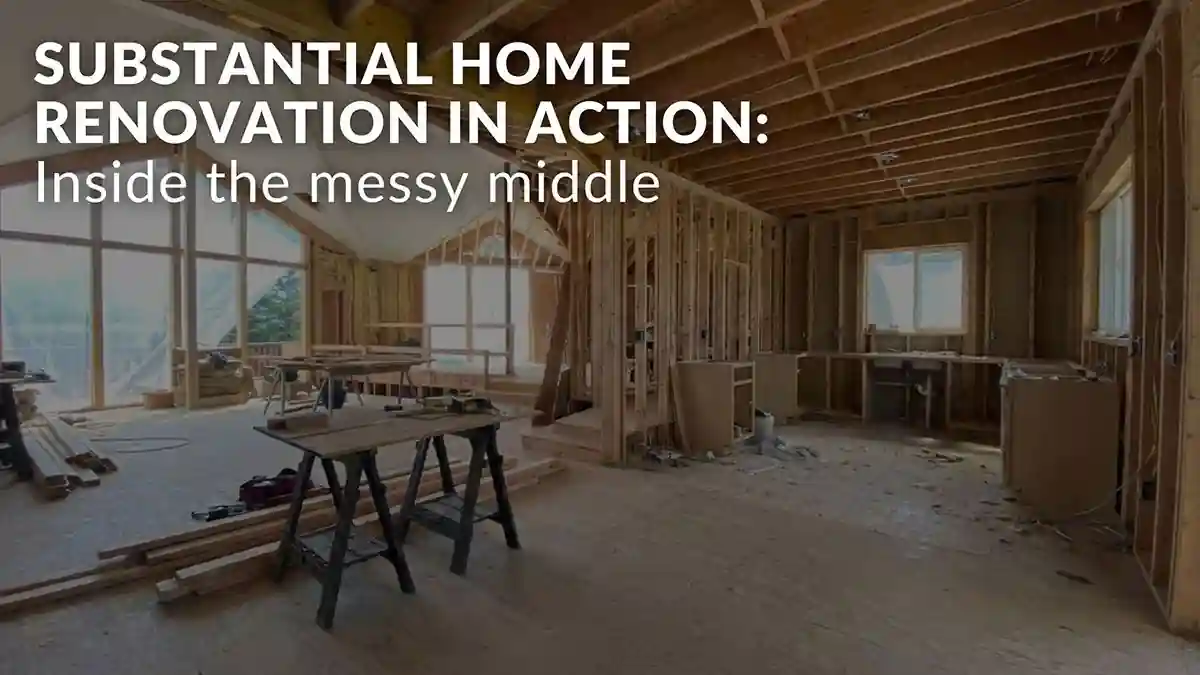
A Quick Gut Check: Does Your Renovation Qualify?
Here is a fast way to tell. Walk through your home and note what is actually staying.
If most rooms are going back to bare framing, if the kitchen and bathrooms are being rebuilt, if the plumbing and wiring are being rerouted, and if walls are moving, you are likely in substantial renovation range. That is a rebuild, not an update.
If you are keeping most of the drywall and finishes and just swapping fixtures, you are probably not close to the 90% line.
What Does Not Qualify as a Substantial Renovation
This part saves you time. The CRA is blunt about it. Finishing a basement on its own, or adding a garage or a deck on its own, does not meet the definition and will not get you the rebate.
An addition on its own does not count either. The existing house has to be substantially renovated, and in the CRA’s own example, the 90% test ignores the addition area.
So a single big room addition with minor updates inside might be a great project. It is just not a substantial renovation for this rebate.
Eligibility Rules Beyond the Construction Work
The scope of work is only half of it. The CRA lets you claim the renovation HST rebate for a new or substantially renovated home used as a primary residence, when you meet the other conditions.
Ask yourself two honest questions. Are you renovating to live in this home? Or to rent it out or sell it? Your intent changes how the rebate applies. If your situation is complicated, a quick talk with a tax professional can save you trouble later.
How to Apply Without Getting Buried in Paperwork
Most substantial renovations go through the CRA’s owner-built path. That path covers homeowners who substantially renovated the house they already own, under the 90% rule.
For an owner-built substantial renovation, you claim on these forms:
- Form GST191, the owner-built rebate application, with Form GST191-WS, the construction summary worksheet, for the federal part.
- Form RC7191-ON, the Ontario rebate schedule, for the Ontario rebate and the 2026 enhanced rebate on the provincial part.
Completing the ONHAP consent section on Form GST191 lets the CRA send your assessed claim straight to Ontario, which pays it. Skip the consent, and you give Ontario the details yourself.
Documents: What You Keep, What You Might Have to Send
In most cases you do not send documents with your application. But the CRA may ask for invoices in some situations, and it may ask you to prove you occupied the home. Keep your original invoices and records for six years.
Only original invoices in the name of the owner or co-owners count. The CRA will not accept estimates or quotes. Start a folder with the first invoice, because rebuilding the paper trail later costs you time and money.
How Frontier Helps You Plan a Rebate-Ready Renovation
A substantial renovation is not a weekend refresh. It is a whole-home renovation that goes down to the studs, and it needs a plan.
Frontier Building Group is a family-owned, women-owned renovation and construction firm in Waterford and Brant County, Ontario. We serve Brantford, Brant County, Haldimand, Hamilton, Norfolk, Paris, and nearby areas.
We cannot approve your rebate. Only the CRA can, and your tax professional confirms whether you qualify. What we can do is plan the work so it fits the CRA’s definition of a substantial renovation, and keep your records clean so filing is simple later.
That starts with the scope. We settle what comes out, what gets rebuilt, and how your layout and systems will work once the walls close up. Then we guide you through design and permitting so the build is compliant. During construction, we run the project and stay your single point of contact, and we help you keep the invoices your claim depends on.
Your Next Step
If you are planning a gut renovation and want to know whether the renovation HST rebate applies to you, start with the scope. Tell us what you want to change, what you want to keep, and how you will live in the home when it is done.