
You are ready to finish your basement. Then you notice a white, chalky film on the concrete walls, or a crusty line along the floor.
Before you pay for framing and drywall, you want to know if you can build over it. Or will your new basement be torn out in a few years?
Our team has found this residue all over a client’s basement floor and walls. What decides the next step is whether the water that left it behind is still coming in.
TL;DR
- White, chalky residue on concrete is often efflorescence. It is the minerals left behind after water moved through the concrete and dried.
- It shows water got in at some point. It does not show that water is getting in today.
- Watch it through a wet season, and check your grading and downspouts.
- If it keeps coming back, or you see damp spots or new cracks, have the basement checked before you build.
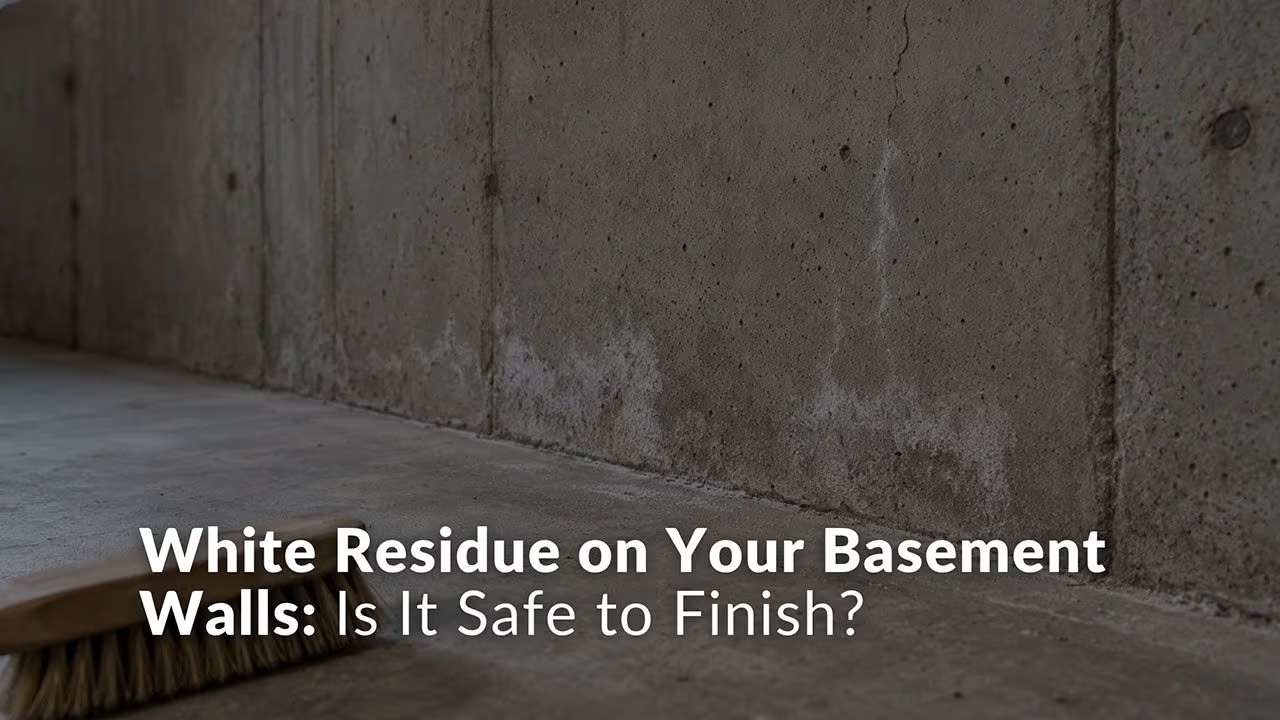
What is the white residue on my basement walls?
White, chalky residue on basement concrete is often efflorescence. It forms when water carries salts through the concrete and leaves them on the surface as it dries.
Concrete has tiny holes all through it. Water moves through a foundation wall or concrete floor and picks up minerals along the way. Then it dries into the basement air and leaves those minerals behind as a powder or crust.
My brother Chris and I talked about this on our BuildCast podcast. I put it this way: “Just like if you let water evaporate out of your glass, there’s still a little bit of white residue inside your glass. It’s the same stuff.”
Canada Brick describes it the same way. It calls efflorescence a crystal deposit of salts that water leaves on the surface of masonry.
Is it efflorescence or mould?
You cannot always tell by looking. But there are clues.
Efflorescence is usually white and gritty, or a hard crust. It sits on bare concrete or block, and it tends to crumble into a dry powder.
Mould is often fuzzy or blotchy, and it can be grey, green or black. It usually grows on drywall paper, wood framing or carpet backing.
Some mould can look powdery too. Looks alone are not proof.
If the residue sits next to anything fuzzy, stained or musty, have it checked before anything gets covered. Mould behind new walls is a much bigger job than a dusty foundation.
Does efflorescence mean water is getting into my basement right now?
Not on its own.
Chris asked me if a homeowner should worry. I told him: “Seeing it alone is not a sign that it’s happening. It’s a sign that it has happened before.”
In a newer home, the water may not have come from outside at all. New concrete and masonry give off construction moisture as they dry. Canada Brick calls this new building bloom, and it usually goes away on its own once the materials dry.
You may hear that any white streak means you need waterproofing right away. That is not always true. Ontario’s new home warranty program, Tarion, treats efflorescence on concrete foundations as a surface condition that can be brushed off, not a defect on its own.
The residue might be left from a problem a previous owner fixed years ago, or it might be from last spring’s thaw. One look will not tell you which.
How can I tell if water is still getting in?
Some clues show up within a few weeks. A full wet season tells you more. Watch through spring thaw or heavy fall rain, when an active problem is most likely to show up.
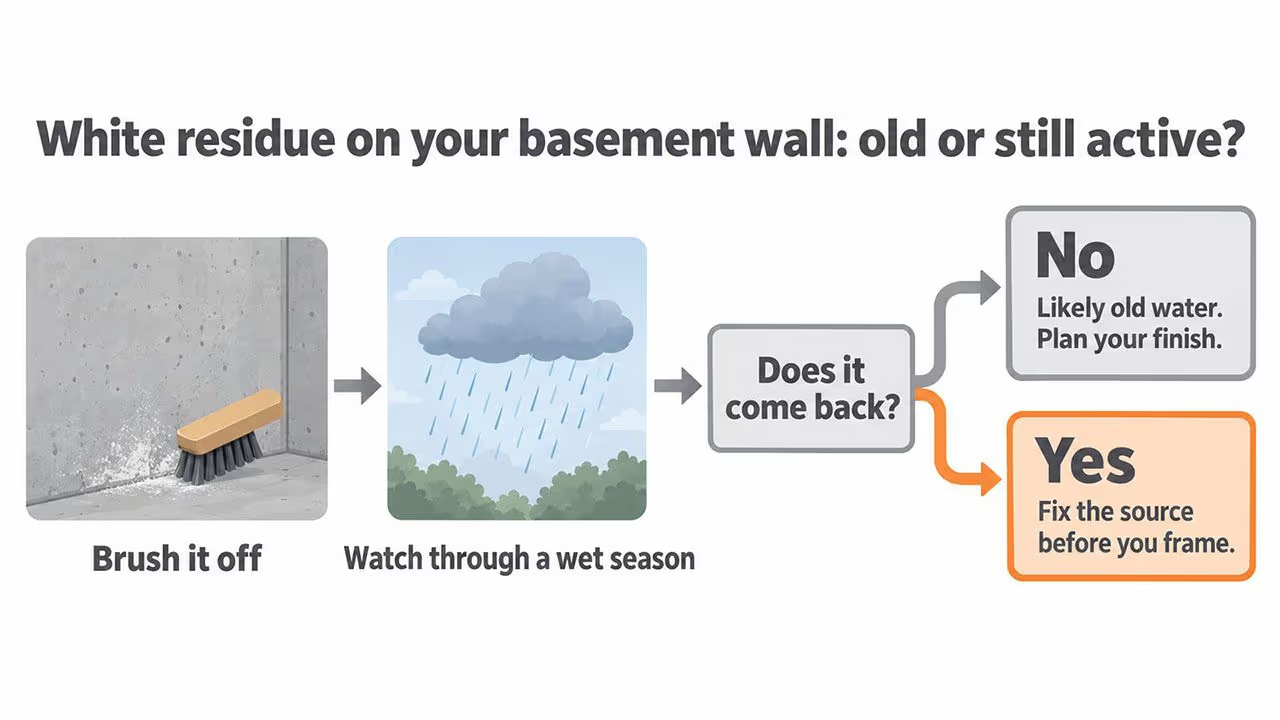
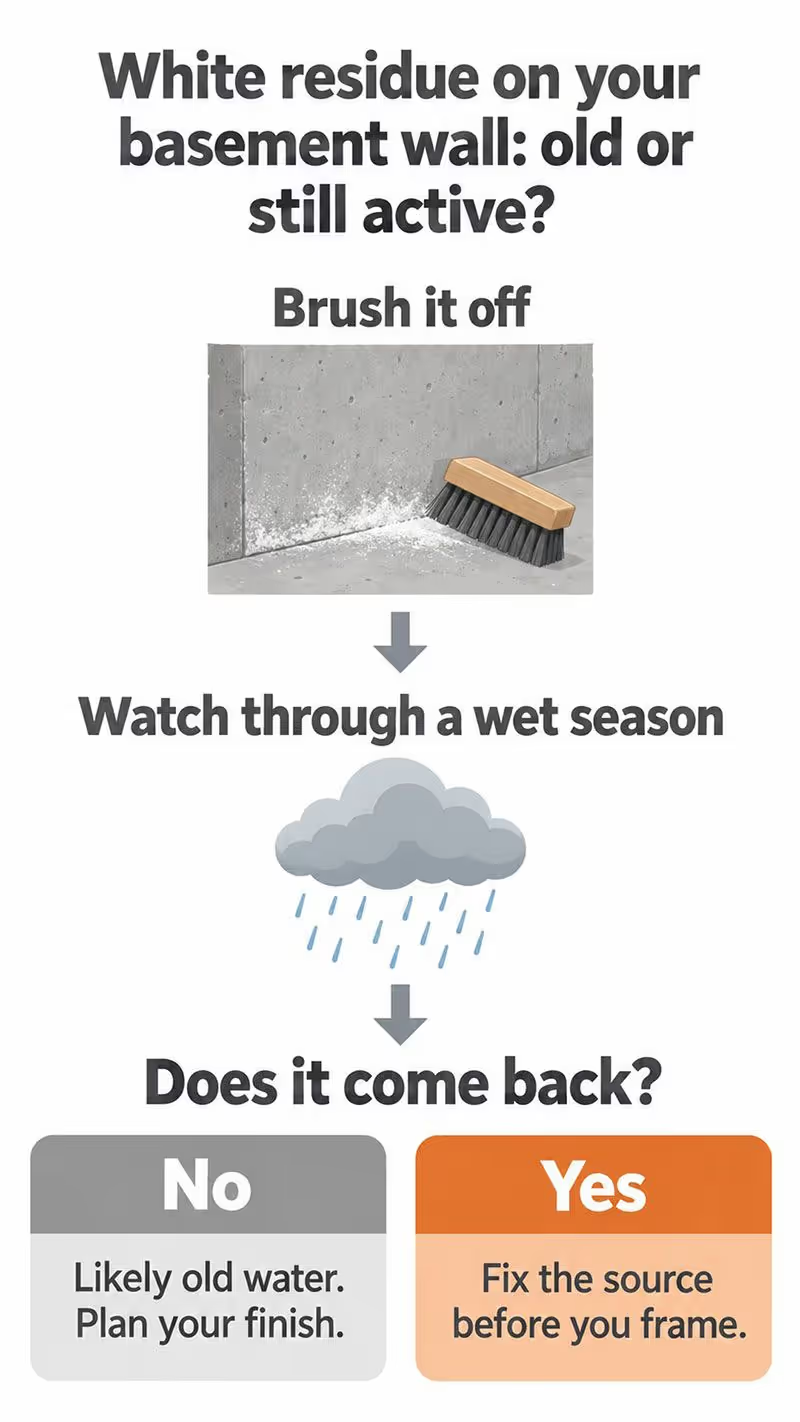
- Photograph the residue first. Then brush it off with a dry, stiff brush and vacuum it up. If it comes back in the same places, water is likely still moving through.
- Tape a square of clear plastic tightly to the wall or floor and leave it for a few days. This plastic sheet test is a quick indicator of moisture in concrete. Droplets under the plastic suggest moisture coming through. Droplets on top can come from humid air on a cool surface. Tarion notes that condensation on basement walls and floors can happen in peak seasons, so treat this as a first clue only.
- Look for damp patches, dark stains, rust on nails or metal, peeling paint and water lines on stored boxes.
- Note where the residue sits. Residue along a crack means that crack deserves a closer look. Residue where the wall meets the floor can have several causes, from water in the soil outside to moisture under the concrete floor.
- Walk around the house. Check whether the ground slopes toward the foundation, and where each downspout empties.
| What you see | What it may mean | What to do before finishing |
| Residue that stays gone through a full wet season, ground that slopes away | Old water that may have been dealt with | Plan your finish, and keep watching after the next big thaw |
| Residue that returns after rain or thaw | Water is likely still coming in | Find and fix the source first |
| Residue along cracks | The crack may be letting water in | Have the crack and outside drainage checked |
| Residue plus damp spots, stains or a musty smell | Active moisture is likely | Get it checked |
Can grading and downspouts fix it?
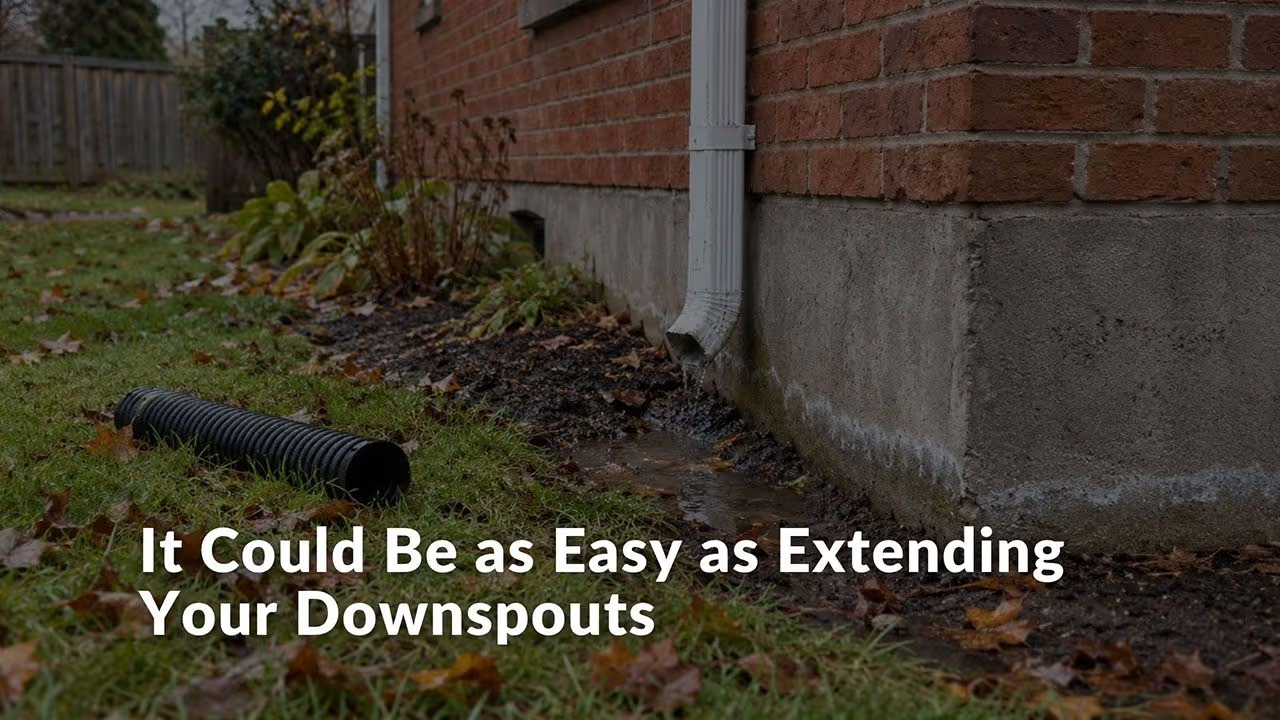
Sometimes, yes, the fix is simple. On the podcast, I said solving the problem “could be literally as easy as changing the slope on the exterior grading.” Grading is the slope of the ground around your house.
If the ground leans toward your house, raise it so rainwater runs away from the foundation. Extending your downspouts can help too. The goal is to carry rainwater away from the foundation to a suitable drainage area. In some cases, a properly installed underground drain may be an option.
When should I have my basement checked before finishing?
Get a professional opinion before you frame if you see any of these:
- Residue that keeps coming back after you clean it
- Water you can see, such as seepage, puddles or wet lines on the floor
- Dampness or a musty smell after storms or spring thaw
- Cracks in the foundation walls or floor, especially ones with residue or staining
- You are not sure where the moisture is coming from
Can I finish my basement over efflorescence?
Yes, if the residue is from an old or resolved moisture problem and the basement is dry. If water is still coming in, find and fix the cause before finishing.
After studs, insulation and drywall go up, you can no longer see the foundation wall. If water is still coming in, it gets trapped behind the new walls. It can soak the insulation and feed mould on the drywall paper.
Often you find out only when a smell shows up or the baseboards stain. By then, what touches the foundation wall may have to come out. You may pay twice.
If you are planning to finish your basement, find out about moisture before design and pricing. It matters even more if the space will become a legal basement apartment. Someone else will live with the result.
Frontier Building Group has nearly 20 years and more than 1,900 projects behind it. When we plan a basement apartment, we check for water problems first. Found one? We fix the source before finishing.
Hear the full conversation on BuildCast
Chris and I talked through efflorescence and what to sort out before you finish a basement in Episode 4 of BuildCast. Watch the full episode on YouTube.
Talk to us before you finish a basement with white residue
Call us at 519.448.3946 before anyone buys drywall.
Tell us what you are seeing. We will tell you what to look for and whether a site visit makes sense. Any fix goes into the plan before the walls go up.