
Building a custom home is one of the largest investments you will ever make, and the way it is taxed can shape your budget, your cash flow, and even your construction timeline. With Ontario temporarily enhancing the new home HST rebate on qualifying properties, this is worth a close look before you finalize your build plan, especially if you plan to build on land you already own or intend to buy.
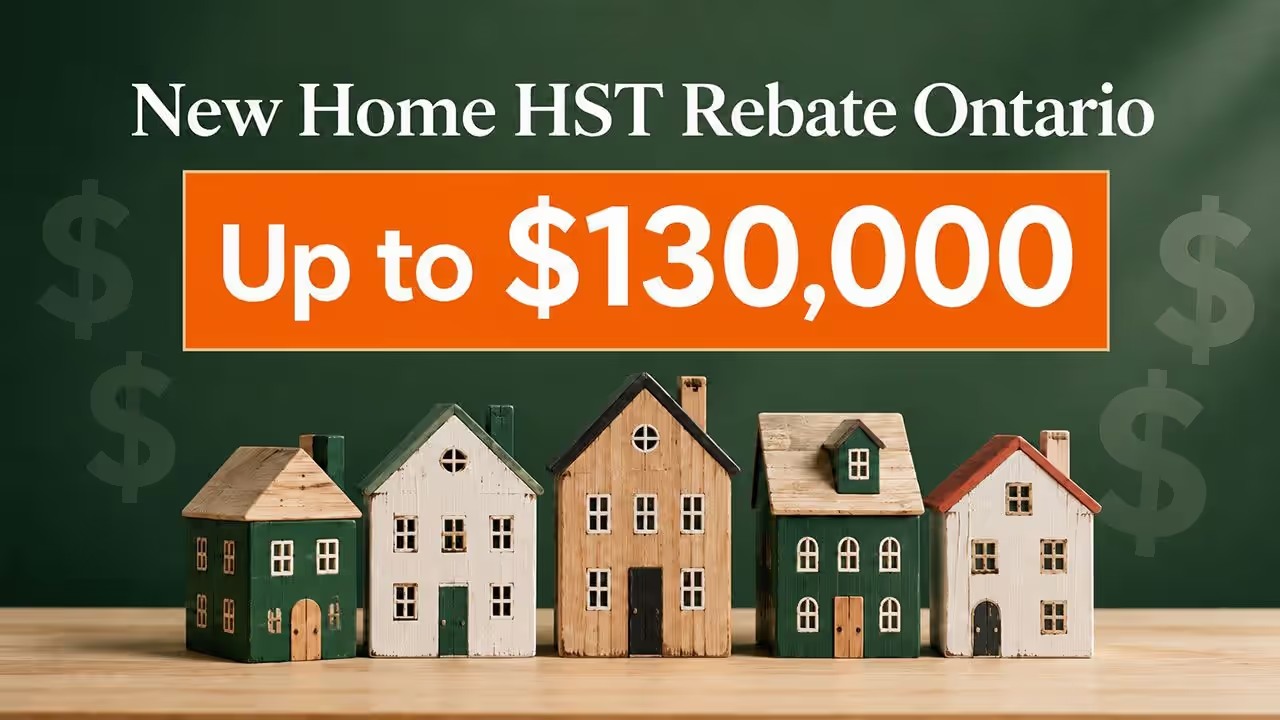
For some qualifying builds, the combined provincial and federal relief could be worth up to $130,000, which is real money that can change how you plan and finance your project.
If building is anywhere on your horizon, it is worth a conversation sooner rather than later, and I’m glad to be that first call.
TL;DR
- Ontario has temporarily enhanced its new home HST rebate for eligible new homes, with significant amounts on the table.
- Custom homes built on your own land usually follow the owner-built rebate path, which is different from buying a finished home from a builder.
- Timing, primary residence use, home value, and documentation all affect eligibility.
- Always confirm eligibility with current CRA guidance or a qualified tax professional.
A quick note before the numbers: This article is general information, not tax advice. HST rebate rules are time-sensitive and partly set through regulation, so confirm any figure or deadline with the Canada Revenue Agency or a qualified tax professional before you build it into your budget.
Quick Eligibility Check for Custom Home Clients
You may be looking at the owner-built path if most of these apply to you:
- You own or lease the land your home will be built on.
- You are hiring a licensed builder to construct the home, rather than buying a finished home and lot together.
- The home will be your primary place of residence, or that of a qualifying relation.
- Your construction or substantial renovation falls within the rebate’s timing window.
- You will keep original, HST-paid invoices in your name.
For homeowners in Brantford, Brant County, Norfolk County, Haldimand County, Paris, Waterford, Ohsweken, and nearby communities, this is especially relevant if your plan is to build on private land, so keep reading.
Does Ontario’s New Home HST Rebate Apply to Custom Homes?
Yes, it can, but the path depends on how your project is structured. This is the single most important point for custom home clients.
- A buyer who purchases a new home and the land directly from a builder generally follows the “purchased from a builder” rebate path.
- A homeowner who owns or leases land and then hires a builder to construct the home generally falls under the “owner-built” rebate path.
CRA describes owner-built eligibility as including people who built, or hired someone else to build, a house on land they already owned or leased. Most custom builds fit that second description.
What Changed with Ontario’s 2026 Rebate Update?
The reason this topic is worth your attention is a 2026 change. Ontario announced a temporary enhancement to its New Housing Rebate for qualifying new and substantially renovated homes, aimed at reducing or temporarily removing HST on eligible new homes valued up to $1 million, and reducing it on eligible homes up to $1.85 million.
This is more than an announcement. The relief has been passed into law in Ontario, with the finer details being set through regulation. Because some of those details are still being finalized, confirm the current forms and procedures before you rely on the rebate.
So what is the rebate worth? In Ontario, the HST on a new home adds up to 13 percent: an 8 percent provincial portion and a 5 percent federal portion. The enhanced rebate returns 100 percent of that 8 percent provincial portion, up to a single maximum set by your home’s value:
| Home value | Maximum provincial rebate |
| Up to $1 million | The full provincial portion, capped at $80,000 |
| Over $1 million, up to $1.5 million | $80,000 |
| Over $1.5 million, up to $1.85 million | Slides down from $80,000 to $24,000 as value rises |
That $80,000 is the most you can get back on the provincial portion. It is a single ceiling, not an amount that stacks from one band to the next. Ontario has also said it would provide additional relief equivalent to up to the full 5 percent federal portion, with eligibility that generally matches the enhanced rebate.
The middle band is where most people get lost, so here is a worked example. Take a qualifying $1.675 million custom home, sitting right in the middle of the $1.5 million to $1.85 million range. The maximum slides evenly from $80,000 at $1.5 million down to $24,000 at $1.85 million. A $1.675 million home is halfway along that slope, so its maximum provincial rebate would be roughly $52,000. The closer the value gets to $1.85 million, the closer the maximum drops toward $24,000.
For a home under $1 million the picture is the simplest and most generous. The enhanced rebate can return the full provincial portion, up to $80,000, and relief on the 5 percent federal portion can add up to roughly $50,000 more. Stacked together, that is where the combined total approaching $130,000 comes from. Subject to final eligibility and claim rules, treat numbers like these as a planning signal, not a promise.
Owner-Built Custom Homes: The Key Distinction
On the owner-built path, you apply for the rebate directly yourself rather than receiving it through a builder at closing. To qualify, the home must generally be intended as your primary place of residence, or that of a qualifying relation. Several project types may fit, including a new detached custom home, a major addition that qualifies under new housing rebate rules, a substantial renovation that meets CRA’s substantial renovation test, or a modular home where it fits CRA’s treatment.
One realistic note. A rebate does not replace a sound construction budget. It may improve your cash flow after you apply, but depending on the final rules, you may still pay HST during the project and claim later. Plan your financing as though you will carry that cost in the meantime.
Eligibility Factors Homeowners Should Confirm
Before construction starts, work through these questions with your builder and tax professional:
- Who owns the land?
- Will the home be your primary place of residence?
- Is the project a new build, a major addition, or a substantial renovation?
- When will construction begin, and when is substantial completion expected?
- Will the home value fall within the rebate bands?
- Which forms apply, and who is responsible for filing?
- What HST-paid invoices and records need to be preserved?
Important Dates for Custom Builds
Timing is one of the easiest things to get wrong, so map these dates against your schedule early.
For the enhanced Ontario rebate on an owner-built home, construction or substantial renovation would generally need to begin on or after April 1, 2026, and on or before March 31, 2027. The work must then be substantially completed on or before December 31, 2029.
There is also a deadline for the claim itself. CRA states that, for owner-built homes, the Ontario filing deadline matches the GST/HST new housing rebate deadline, and claimants generally have up to two years after the applicable base date to file.
Documents and Invoices to Keep
This is where many homeowners leave money on the table, and it is avoidable.
CRA lists Form GST191 and Form GST191-WS for owner-built housing rebate claims, plus Form RC7191-ON for the Ontario owner-built rebate. Keep the original invoices and documents used to complete those forms for six years. Only original invoices in your name, or a co-owner’s name, are acceptable. Estimates and quotes are not accepted as proof.
Where Frontier Building Group Helps
To be clear, Frontier Building Group is a planning and building partner, not a tax advisor. We do not file rebate claims for you. What we do is run a disciplined custom home process that keeps your project organized, and that organization happens to support rebate-readiness.
Our process moves through discovery and feasibility, design and budget, approvals and warranty, site preparation and build, finishes and walkthrough, and after-care and support. Along the way, early lot review helps confirm whether your property can support the home you want, permit and municipal coordination helps clarify the schedule milestones that matter for rebate timing, and organized record-keeping helps you hold onto the clean invoices CRA expects to see.
A few details set us apart. We are an HCRA Licensed Home Builder and Vendor, Licence #B64700, and we offer design and permit support, local site planning, and one accountable team from lot review to handoff. We serve Brantford, Brant County, Norfolk County, Haldimand County, Ohsweken, Paris, Waterford, and nearby communities.
Common Mistakes to Avoid
- Assuming every new build qualifies. Eligibility depends on use, value, timing, ownership, occupancy, and CRA rules. None of it is automatic.
- Treating a custom home like a builder-sale home. Owner-built projects use a different claim process, so the path is not interchangeable.
- Losing invoices or relying on estimates. CRA requires original invoices and rejects estimates or quotes as proof.
- Ignoring the start and completion dates. The construction window and the December 31, 2029 completion date matter a great deal.
- Waiting until construction is underway to ask tax and financing questions. By then, your options for structuring things cleanly are far more limited.
Ready to Plan Your Build?
Planning to build on your own land? Reach out and let’s talk it through before you finalize your lot, drawings, budget, or construction timeline. I’m happy to sit down with you, look at your property, and help you understand what a rebate-ready build could look like. Getting the land, design, permits, budget, and documentation aligned early is what makes the rebate question easy to answer later.
The right build starts with the right plan, and the right plan starts before the first shovel hits the ground. When you’re ready, I’d love to hear what you’re thinking of building.