
You already own land in Norfolk County. Now you are deciding whether to build an ADU or buy another house, and you are trying to work out which path to take without wasting money on the wrong one.
Here is the news that is pushing this question right now. Norfolk County just posted 8.9 months of housing inventory in July 2026. That is the highest level on record for the region.
The MLS Home Price Index fell alongside it, down 3.9 percent year over year to $550,600. Prices are softening while supply climbs, which is the backdrop to this whole decision.
So is this the moment to sell and buy elsewhere while inventory sits at a record high? Or does it make more sense to build on the land you already have and stay put?
We hear both questions from Norfolk clients right now. The honest answer is that there is no single right choice. It depends on what you are trying to accomplish and what each path costs you to get there.
TL;DR
- Norfolk County hit 8.9 months of housing inventory in July 2026, the highest level on record, while the MLS Home Price Index fell 3.9 percent year over year to $550,600
- Building an ADU keeps you on land you already control. Buying a different house means a new mortgage, new land transfer tax, and a new set of unknowns
- The right choice depends on the job you are solving: housing an aging parent close by, or earning rental income without buying in another town
| Build an ADU | Buy a Different House | |
| Upfront cost | Construction loan or HELOC draw against your existing home | Down payment plus mortgage on the new house |
| Mortgage qualification | Existing mortgage stays in place; lenders may count some future rental income | New mortgage application, new stress test, new approval |
| Land transfer tax | None | Payable on closing, based on purchase price |
| Legal costs | Permitting and design-related legal work | Full purchase closing costs |
| Property tax | Reassessment of the same property | A new assessment on the new address |
| Insurance | Update to your existing policy | New policy on the new address |
| Utility servicing | Often shares or extends existing water, sewer, and hydro connections | Already serviced, but you inherit whatever condition it is in |
| Resale flexibility | Tied to your existing title; the ADU sells with your home | A separate title, sold on its own terms |
What Record Inventory Changes for Norfolk Homeowners
More months of supply means buyers have more homes to choose from. It also gives them more room to negotiate.
A softer MLS Home Price Index means listed homes are taking longer to sell. Sellers are adjusting their expectations.
If you are shopping for a different house, both of those conditions work in your favour right now.
If you build instead, you skip the parts of a move that cost the most. No land transfer tax. No agent commissions on a sale and a purchase. No packing up and relocating your household. You add space to the home you already have, in the community you already know, and you keep the mortgage you already hold.
Starting With the Job, Not the Structure
Before you compare dollars, name what you are actually trying to solve. We see two reasons come up most often with Norfolk clients.
Housing an aging parent close by. The goal is proximity and privacy, not income. Your parent needs their own kitchen and their own door. But you want to be a short walk away, not a drive away.
Generating rental income without becoming a landlord in another town. You want a second income stream. But managing a tenant at a property you do not live near adds a layer of work most homeowners underestimate until they are living it.
Each job weighs the numbers differently. A parent-housing job puts almost no weight on vacancy risk. An income job puts a lot of weight on it.
Know which job you are solving before you look at the numbers below.
Comparing the Cost of Building and Buying
This is where the choice between building and buying gets concrete.
An ADU is usually funded through a construction loan or a home equity line of credit against your existing property. Buying works differently. A different house needs a conventional mortgage, which means a fresh application, a fresh stress test, and approval based on your income and the new property, not the equity you already hold.
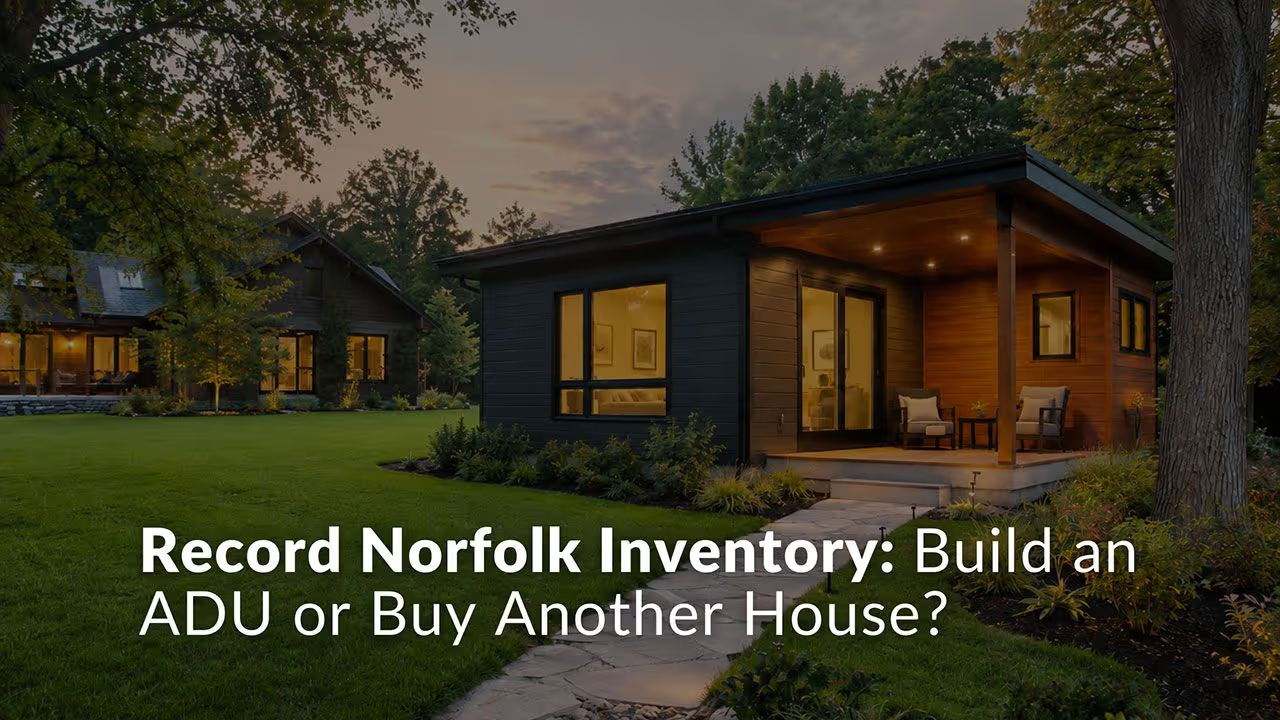
Our current pricing guide for the region puts a detached garden suite or ADU in Brantford, Norfolk, and Paris at $150,000 to $350,000. The range depends on size, foundation work, and finishes.
Compare that to a purchase in Norfolk at the current MLS Home Price Index of $550,600, plus land transfer tax and legal closing costs on top.
Tax treatment splits the two paths too. An ADU triggers a property tax reassessment on your existing property, not a new bill on a new address. Buying a different house means a full, fresh assessment from day one.
There is a rebate angle worth checking as well. An ADU that qualifies as a major addition under CRA rules may be eligible for the ADU HST rebate. A newly built custom home has its own HST rebate path.
Checking Servicing Before You Design
An ADU usually extends your existing water, sewer, and hydro connections rather than needing entirely new servicing. That is often cheaper than starting fresh. But check the assumption before you design anything, because what the existing services can carry sets the ceiling on what you can build.
A few things are worth confirming early. An older electrical panel may need an upgrade before it can feed a second kitchen and heating system. A septic system sized for one household may not pass approval for a second dwelling. And on a rural Norfolk lot, well capacity matters, since a second unit adds real daily demand.
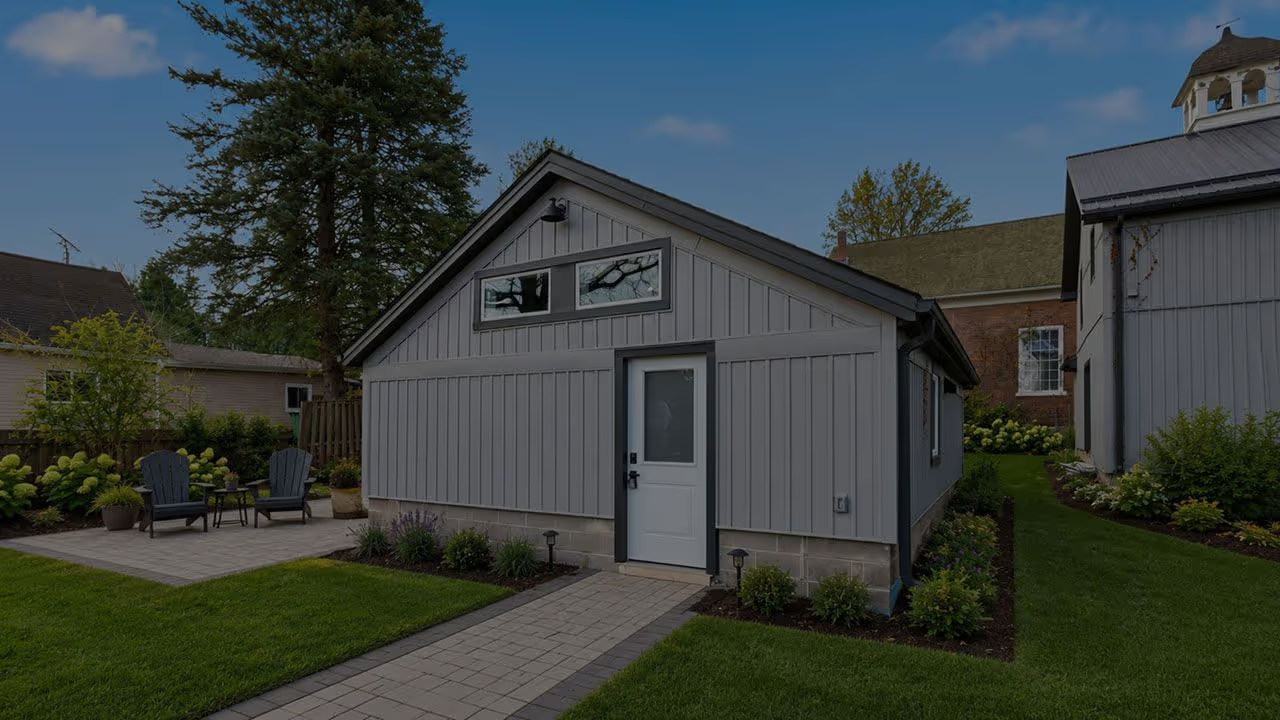
Our breakdown of ADU water, sewer, septic, and hydro considerations walks through two real garage conversion projects we handled that landed at different price points. Our Norfolk County garage conversion on Hewitt Street came in between $190,000 and $225,000, because of what turned up in the ground and what the services could carry. Septic was the critical path on a small lot, and the second unit needed a 200 amp electrical upgrade.
Buying is the reverse. The servicing is already in place, so there is nothing to extend. But you inherit it as-is, along with whatever the previous owner did or did not maintain, and you find out its real condition only after you own it.
Weighing Vacancy and Resale When You Rent
The next two factors only matter if you plan to rent. If you are building or buying to house a parent, you can skip this section.
Vacancy risk is the piece homeowners tend to overlook when they treat an ADU as an investment. If your ADU sits empty between tenants, you lose the rental income you were counting on. But it does not touch your ability to make your own mortgage payment.
A property you bought specifically to rent works differently. If it sits vacant, it can hit your ability to cover that mortgage directly, since the purchase was likely qualified in part on projected rent.
Resale flexibility splits the same way. An ADU stays tied to the title of your main home, so it sells when your home sells. Two separate properties are different. You can sell one and keep the other. Neither is better on its own. They just suit different plans: one property to manage and pass on as a whole, or two you can move in and out of separately.
Deciding Between Building and Buying
Whichever path fits, the choice turns on your situation. There is no number that works for everyone.
An ADU built to house a parent avoids a second mortgage and keeps the family on one property. A rental is more about financing. A garden suite keeps things simpler through a HELOC or construction loan, while a bought rental in another town brings full mortgage qualification and a tenant you manage from far away.
Here is how to pin down which one is yours.
Confirm with Norfolk County whether an ADU is permitted on your lot as currently zoned. Do this before you commit to a design.
Get a written construction cost estimate from a licensed builder, then put it against a real resale listing price rather than a rough guess. Comparing what it costs to build against what it costs to buy only works when both figures are real.
Ask a lender to pre-qualify you for both a construction loan and a conventional mortgage. That way you are comparing real numbers, not estimates.
Talk with any family member who would live in or near the ADU before finalizing the plan. The arrangement affects them as much as it affects your budget.
If your lot has zoning questions or servicing unknowns, get those answered before drawings begin. Our guide on avoiding the most common buildability mistake in Norfolk County covers what typically gets assumed too early in a build. The same lessons apply to an ADU on an existing lot.
Taking the Next Step on Your Lot
If you already own land in Norfolk County and want a clear answer on whether an ADU fits your lot and your budget, that is a feasibility conversation, not a guess.
At Frontier Building Group, we work through zoning, servicing, and cost with homeowners across Brant, Norfolk, and Haldimand before a single drawing gets made. Reach out to start that conversation before you decide between building and buying.
Get in touch for a free ADU feasibility conversation before you decide between building and buying. Call 519-448-3946 or email info@frontierbuildinggroup.com.